Common questions teachers ask when running this lesson.
Where is Dumfries House and why is the King using it?
Dumfries House is a Georgian country house in Ayrshire, Scotland, that the King (then Prince Charles) helped save for the nation in 2007. It's now run by his charitable foundation and he uses it to host serious convening events — it's not a state residence. That is the point: this summit sits outside government protocol on purpose.
Which AI companies actually turned up?
The article names Nvidia (Jensen Huang, CEO), OpenAI (Sarah Friar, CFO), and Google DeepMind (Sir Demis Hassabis, co-founder). It also lists Anthropic in the invited group but does not name a specific Anthropic representative in the reported quotes.
What did the King actually ask them to do?
He asked whether the group could develop a 'shared set of principles' to 'help guide the future application' of AI. That is a values framework, not a law or a regulator. He explicitly framed their task as keeping AI 'in the service of humanity, community and the natural world' — not a technical brief.
Is 'existential danger' the King's own phrase, or borrowed?
It's his own words in the piece. The article quotes him warning of the 'existential dangers of such technologies falling into the wrong hands, and being used in potentially catastrophic ways'. Related industry voices in the wider context (Suleyman, Hubinger) use similar language, so the King is entering an existing conversation, not starting a new one.
Who is Kanishka Narayan — is the AI Minister role new?
Kanishka Narayan is named as the UK's AI Minister. AI-portfolio ministerial roles have been created only recently, sitting inside DSIT-adjacent departments; the exact remit changes by administration. His presence at the King's summit is the article's signal that the government is at the table — via one minister, alongside CEOs.
Does the article say anything about pupils, schools or education?
Not directly. The frame is CEOs, government and society-wide risk. That is precisely why it lands well as a Citizenship lesson: pupils are the citizens whose future gets decided at this table, and they are not in the room — which is a strong hook for the stakeholder-map activity.
Common misconceptions
What pupils tend to think, and what to say back.
Pupils often say
The King has actual power over AI companies now.
It's actually
He doesn't. UK monarchs are constitutionally above party politics and cannot pass laws. What Charles did here is convening power, not legislative power — he brought people to a table because of who he is, but the rules are still set by governments, regulators and the companies themselves. Convening a conversation is not the same as writing a rulebook.
Try asking
If the King can invite the world's biggest AI CEOs and they all show up, what does that show he does have — even without legal power?
Pupils often say
If Nvidia's CEO says safety is 'paramount', they must be doing it.
It's actually
The article gives Jensen Huang's words as-said, without independent verification. In the same breath he defended 'open models' — which some critics say make AI easier to misuse. Saying safety is paramount is a public statement; whether Nvidia's shipped products actually reflect that is a separate empirical question the article doesn't answer.
Try asking
What evidence, beyond the CEO's own words, would you want before agreeing Nvidia treats safety as paramount?
Pupils often say
If Demis Hassabis says AGI is a 'few short years away', then AGI is coming in a few years.
It's actually
Sir Demis is a serious voice — DeepMind co-founder, now inside Google. But 'probably only a few short years away' is a prediction, not a delivery date, and he himself adds that risks are 'definitely non-zero'. Other experts think AGI is decades off or may never arrive in the way he means. Treat one prediction as one data point.
Try asking
How would you decide which AI predictions to weigh heavily and which to file under 'we'll see'?
Pupils often say
The Pope's advisor being there is a bit weird — this is a tech story.
It's actually
The article names the Pope's advisor deliberately. AI raises questions the tech industry alone doesn't answer — about meaning, work, fairness, what counts as a person. Bringing a religious perspective to a technical summit is one signal that the King is trying to widen the frame beyond 'what's technically possible' to 'what should we actually build'.
Try asking
Which other voices — not tech CEOs — would you invite to the same table, and why?
Pupils often say
Sarah Friar of OpenAI just said all the right things.
It's actually
She said AI could solve 'hardest problems' and asked 'how we ensure it always serves people'. Fine words, but note what she did NOT commit to: specific rules, third-party audits, or slowing releases. The article reports her tone accurately — grateful, collaborative — while making clear she left the concrete asks to others. That is worth spotting.
Try asking
What would a CEO have to say at the summit for you to count it as a commitment, not just a nice sentence?
5-minute prep
Five ready-to-run ways to open this lesson. Pick one, copy the prompt, paste it into ChatGPT or Copilot.
Read this first1 min
The story in one paragraph
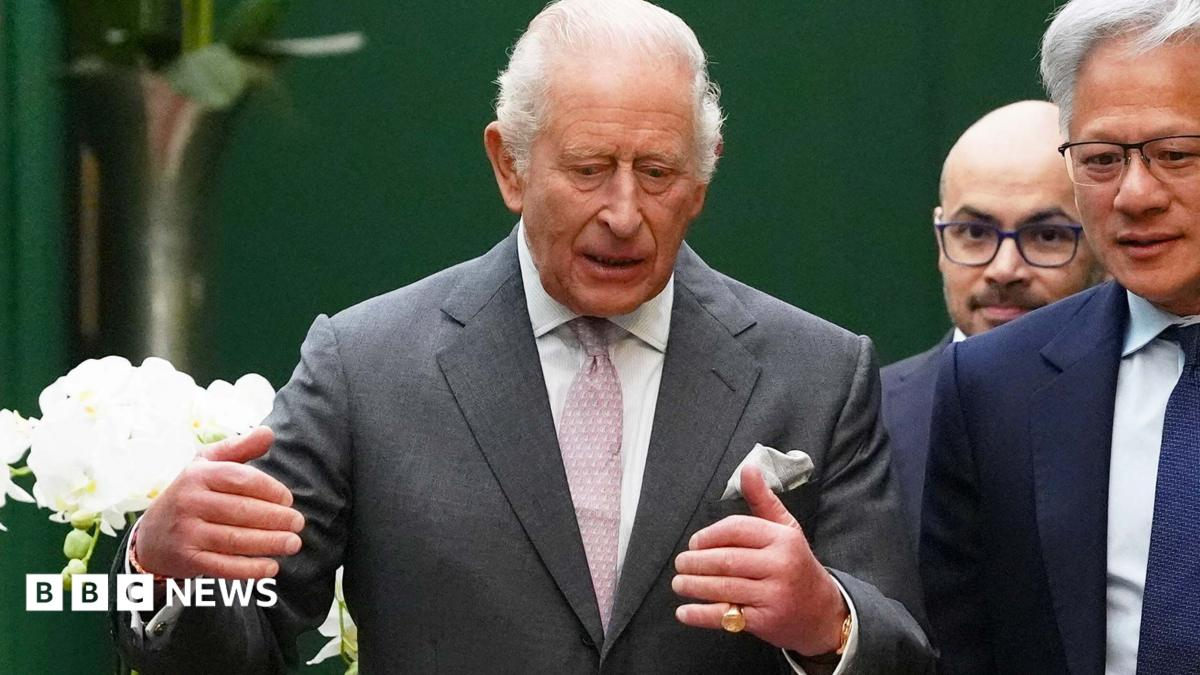
King Charles called AI's top CEOs to a summit at his Scottish estate at Dumfries House. He told them AI risks 'developing darker capacities — perhaps even to take life' and warned of 'existential dangers' if it falls 'into the wrong hands'. Nvidia's Jensen Huang, DeepMind's Sir Demis Hassabis, OpenAI's Sarah Friar, plus the UK's AI Minister Kanishka Narayan and the Pope's advisor were all in the room.
I am about to run a lesson on the BBC News story 'King Charles warns of "existential danger" of AI falling into wrong hands' (17 Sep 2026, https://www.bbc.co.uk/news/articles/c65ymj7njvl7o). Please give me three short paragraphs I can read aloud in five minutes that fairly summarise (1) who the King invited, (2) what he actually said, and (3) how the CEOs in the room responded. British English, plain register, aimed at a Y10 class.
Three phrases to hold1 min
'existential danger' · 'in the service of humanity' · 'the future is not yet written'
The King used 'existential danger' — the strongest word he could pick. He told the CEOs their job is to keep AI 'firmly in the service of humanity, community and the natural world'. And Demis Hassabis of DeepMind replied that 'the future is not yet written'. Every argument today loops back to one of these three.
Please write me three quick teacher lines I can use to introduce a Y10 class to the King Charles AI summit BBC story (https://www.bbc.co.uk/news/articles/c65ymj7njvl7o). Each line names one of these three phrases — 'existential danger', 'in the service of humanity', 'the future is not yet written' — and says what a careful reader should hold in mind about it. British English, plain register.
The room to picture1 min
Nvidia · OpenAI · DeepMind · Anthropic · a UK Minister · the Pope's advisor
Ask the class to picture the room. The King at the head. Around the table: Nvidia (world's most valuable company, $5.15tn), OpenAI (ChatGPT), Anthropic (Claude), Google DeepMind. Beside them: Kanishka Narayan, the UK's AI Minister. And, unusually, the Pope's advisor. Who is not in the room is the class's first question of the day.
Please give me one classroom prompt for a Y10 Citizenship lesson that asks pupils to picture the King's AI summit room (from the BBC article https://www.bbc.co.uk/news/articles/c65ymj7njvl7o) and name three groups who are NOT in the room but should be. British English, one paragraph, warm and provocative.
The word to challenge1 min
Ask which word in 'darker capacities' is doing the work
The King said AI 'risks developing darker capacities — perhaps even to take life'. Ask which one word the class would want to interrogate. 'Darker' assumes AI has a moral direction. 'Capacities' assumes AI grows abilities, not just does what it's told. 'Perhaps' is doing a lot of quiet hedging. Every reading of this article starts by picking one of those three.
Please give me one classroom prompt for a Y10 English lesson that asks pupils to pick the single word in the phrase 'darker capacities — perhaps even to take life' (from the BBC article https://www.bbc.co.uk/news/articles/c65ymj7njvl7o) that is doing the most quiet rhetorical work, and to explain their pick in two sentences. British English.
If it derails1 min
A fallback line if pupils go monarchy or apocalypse
The article has two magnets — the monarchy question ('should the King be doing this at all?') and the extinction question ('will AI actually kill us?'). If it tips too far into either, gently redirect. Suggested line: 'We're not here to argue about the monarchy, and we're not here to decide whether AI will end the world. We're here to notice who sat around that summit table, what they said, and what a class of Y10 pupils would want asked next.'
Please give me one calm classroom line I can use to redirect a Y10 discussion of the BBC King Charles AI summit story (https://www.bbc.co.uk/news/articles/c65ymj7njvl7o) if it tips into a monarchy debate or Terminator-style apocalypse conversation. British English, warm, non-confrontational.