AI's hidden energy bill
Why every prompt costs electricity and water, and how to use AI more lightly
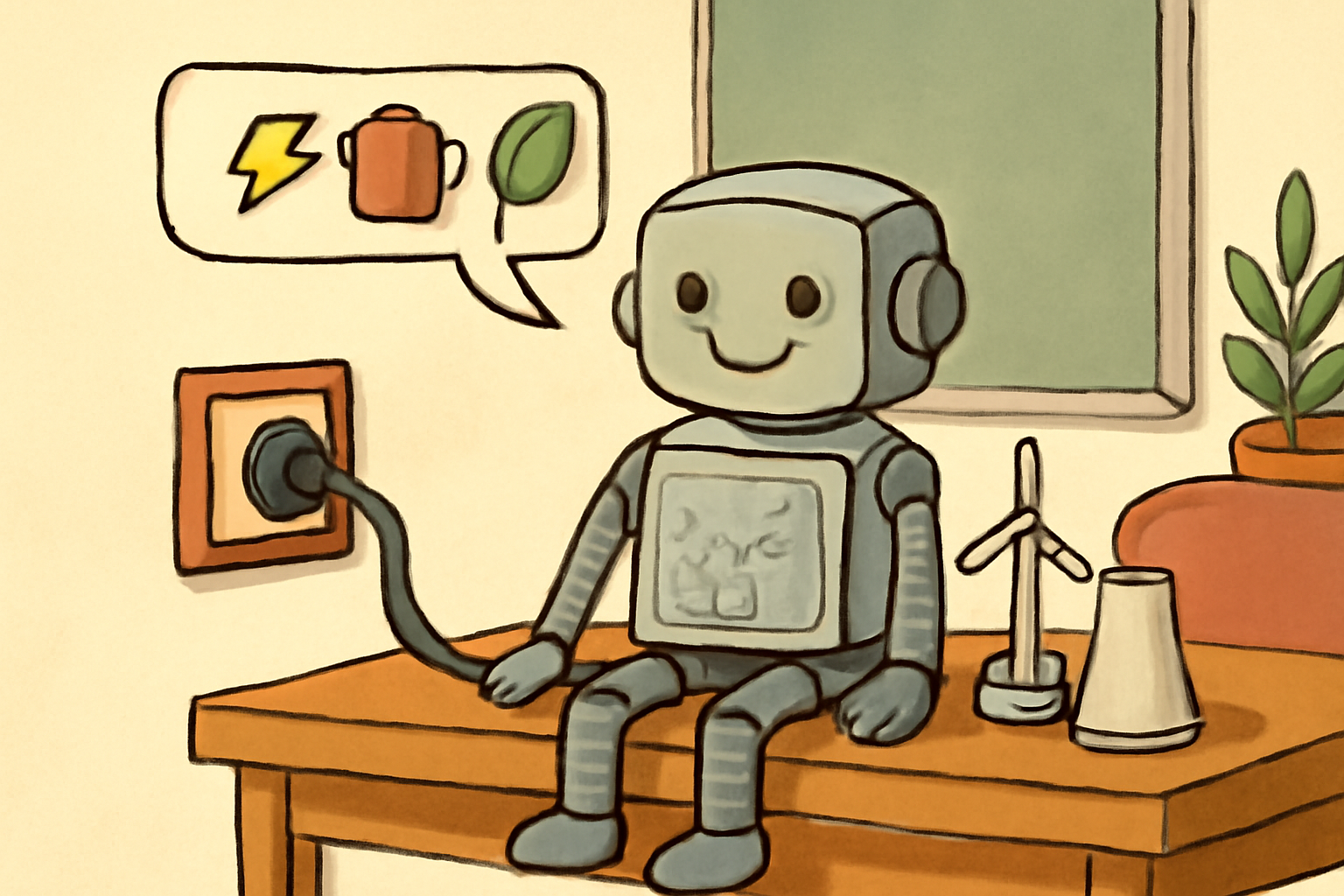
The chatbot in your pocket runs a warehouse
Before we say anything, let's watch AI's appetite change in real time.
Open ChatGPT (or Gemini, or Copilot) at the front. Ask it the three prompts below in order. Time each response with a stopwatch on your phone. Notice which one takes longest, which one produces the most text, and which one your teacher's laptop fan whirs the hardest for.
That fan noise is the tiny tip of a very big iceberg.
When you tap out a question to ChatGPT, it feels weightless. A tiny bit of typing, a few seconds of waiting, an answer on your screen. Nothing seems to happen anywhere else.
But somewhere, in a giant shed the size of a small town, thousands of computer chips just fired up to answer you. Fans spun. Water pumped through cooling pipes. Electricity flowed in from a power station that had to burn something, split something, or catch some sunlight to make it. That one question you asked cost roughly ten times what the same question would have cost as a Google search.
Over the next thirty minutes we'll take AI's hidden energy bill apart, see who pays it, and pick up the handful of small habits that add up to using AI a lot more lightly.
Write me a haiku about a rainy Monday morning.
Write me the opening chapter of a novel set in a future where teenagers travel to school by hoverboard. About 500 words.
Here is a table of 30 pupils and their weekly homework hours across a whole term. Analyse the trends, spot any unusual weeks, and suggest three changes to the class homework schedule that might help. (Paste any big block of made-up numbers.)
Look at the three responses together and ask the class:
- Which one took the longest to arrive? Which one produced the most words on screen?
- If every AI question uses electricity, which of these three probably cost the most?
- Did we actually need the big one? Could a person, a calculator, or a quick Google have done any of these instead?
- Multiply your guesses by every teenager in the country asking the same kind of thing a few times a day. What might that add up to?
Hands up: how many pupils in the room used an AI chatbot at least once yesterday? Now how many used it five or more times? Do a quick tally on the board. Multiply by the roughly 800,000 secondary pupils in England. Even a rough number lands the point: little clicks turn into an awful lot of electricity when a whole country is clicking.
Where the electricity actually goes

Your phone barely warms up when you use ChatGPT, so it's tempting to assume the AI is happening on your device. It isn't. Your phone just sends the question over the internet to a data centre, which is a warehouse full of specialist computer chips designed to run AI models very quickly.
Those chips do the actual thinking. They use a lot of electricity while they do it, and they get hot enough that the data centre has to cool them down, usually by pumping cold water past them or by evaporating water into the air. So every question you ask spends a bit of electricity and a bit of water, in a building you'll probably never see, often on a different continent.
One rough figure worth remembering: a typical ChatGPT question uses about ten times the electricity of a typical Google search. Not because Google is magic, but because AI models are much bigger and do far more work per answer.
If you had to draw the journey your question takes from your phone to the AI's answer, what would you draw?
In pairs, pupils sketch the pipeline: phone, internet, data centre, chips, cooling, answer coming back. Prompt them: where in that pipeline does the electricity get spent? Where does the water get used? Share two or three sketches. The point to land: the cost is real, it's just invisible to the person clicking.
Two big bills: training and asking
AI models come with two very different energy bills, and it helps a lot to know which one you're paying.
Before you tap the cards below, have a guess: if AI has an environmental cost, when is the biggest chunk of that cost racked up?
Tap each card to reveal.
Training
This is where the AI is built, before anyone gets to use it. Engineers feed it billions of examples over weeks or months, running thousands of chips flat out the whole time. Training one big model like GPT-4 is thought to have cost roughly the same electricity as several hundred UK homes use in a whole year, plus hundreds of thousands of litres of water for cooling.
Asking (inference)
This is what happens every time someone types a prompt. Each single question is small compared with training, but there are hundreds of millions of them a day, so the total quickly overtakes the training bill for any popular model. This is the part YOU personally affect every time you click send.
Idle and standby
Data centres also spend electricity when nobody's asking them anything: keeping chips warm, keeping cooling systems running, keeping the whole warehouse ready for the next spike of traffic. It's a smaller slice than training or asking, but it never sleeps.
You can't do much about training or standby, but the middle one is entirely in your hands. Every question you send is a coin dropped into the inference jar.
In pairs, pupils write down one real AI activity from the last week (making a picture, drafting an essay, translating something, generating a video). Ask them which bill it added to (asking) and roughly how big a splash they think it made. Push back gently: the bill nobody sees is often the biggest one.
How big is 'a lot'?
One AI question, on its own, is genuinely tiny. Roughly enough electricity to power an old lightbulb for a couple of minutes. Not a scandal.
The reason AI's energy cost matters is the same reason bias matters: scale. ChatGPT alone answers something like a billion questions a week. Multiply a tiny cost by a billion and you get a very big cost, quickly. Add image generation (which uses much more electricity per go than text), add video generation (which uses much more again), and add every AI feature quietly baked into every app you use, and the numbers stop being tiny.
Some useful rules of thumb to keep in your head: a text prompt is small, an image prompt is roughly ten to forty times bigger, a short AI video is bigger again. And every single one goes on the tab.
Motion: If AI is useful, its energy cost isn't my problem.
Split the class in two. Left side agrees, right side disagrees. Three minutes to prepare, five minutes to hear both sides. Look for pupils who reach for scale ('yeah but if a billion people do it...') and reward that thinking. Wrap with a hands-up vote after the debate, not before.
Four habits to use AI more lightly
You don't have to stop using AI to use it more lightly. Four small habits, done routinely, will cut most of the waste out of your day.
Before you tap the cards below, have a guess: if you were teaching a friend to use AI without burning through electricity, what would you tell them?
Tap each card to reveal.
Ask if AI is even the right tool
A calculator, a search engine, a dictionary, or your own head is often faster, cheaper, and uses a fraction of the electricity. Reach for AI when you actually need what it's good at, not by reflex.
Use the smallest model that works
The biggest, cleverest AI models cost far more per question than the smaller ones. If you're doing a quick translation or summary, a lighter model does the same job for a fraction of the energy. Many apps let you pick.
Batch your questions
Every separate prompt is a fresh round-trip to the data centre. Asking one prompt with three questions inside it is much cheaper than sending three separate prompts. Same answer, one third of the trips.
Don't ask for waffle
Long-winded prompts and long-winded answers both cost more electricity. Ask for what you want in as few words as make sense, and ask for the answer to be short too.
None of these habits mean giving up AI. They mean using it like something with a real cost, because it is.
Give the class one task, for example: 'Get a five-word definition of mitochondria.' Half the room writes a chatty prompt with please and thank you and full sentences. The other half writes a tight, five-word prompt. Both try it at the front. Compare the length of the answers that come back. Point out that both the question AND the answer cost electricity, so the tight prompt has just saved two round trips of waste.
Bad prompt, good prompt

The four habits catch waste at the level of how you use AI. There is also something you can do BEFORE you hit return: write a lighter prompt.
Every word you send costs a bit of electricity. Every word the AI writes back costs a bit more. So the game is simple: ask for exactly what you need, and ask for the answer to be short. No fluff in, no fluff out.
The two prompts below ask for the same information. One of them will roughly quadruple the energy cost for no extra benefit.
Hi there, hope you're having a great day! I was wondering if you would be able to help me out with my Geography homework please. I need to know about renewable energy sources, and could you maybe write me a really detailed answer explaining all of them in lots of depth, with lots of examples and lots of interesting facts, so I can really understand the topic properly? Thank you so much in advance!
Roughly 80 tokens in, and the polite waffle guarantees the AI will fire back several hundred tokens of answer to match your tone. That's four or five times the electricity of the tight version, for information you could get from three bullet points.
List five renewable energy sources for a Y9 Geography homework. One sentence each. No preamble.
Roughly 20 tokens in, and the AI answers in about 50 tokens out. Same information, a quarter of the electricity. The homework is also easier to read, which is a bonus.
Give each pair a bloated prompt and ask them to rewrite it in under 25 words without losing the point. Then run both versions live at the front and compare the length of what comes back.
Try these to trim:
- Please could you give me a really nice, long, detailed explanation of the water cycle, thank you.
- Hi! Would it be OK to ask you to write me a nice paragraph about Henry VIII's wives?
- I was wondering if you might be able to help me out with a full list of the planets in the solar system, in as much detail as possible.
Celebrate the tightest rewrites. Point out that a tight prompt is not just kinder to the planet, it's usually a better prompt full stop.
So what would you do?
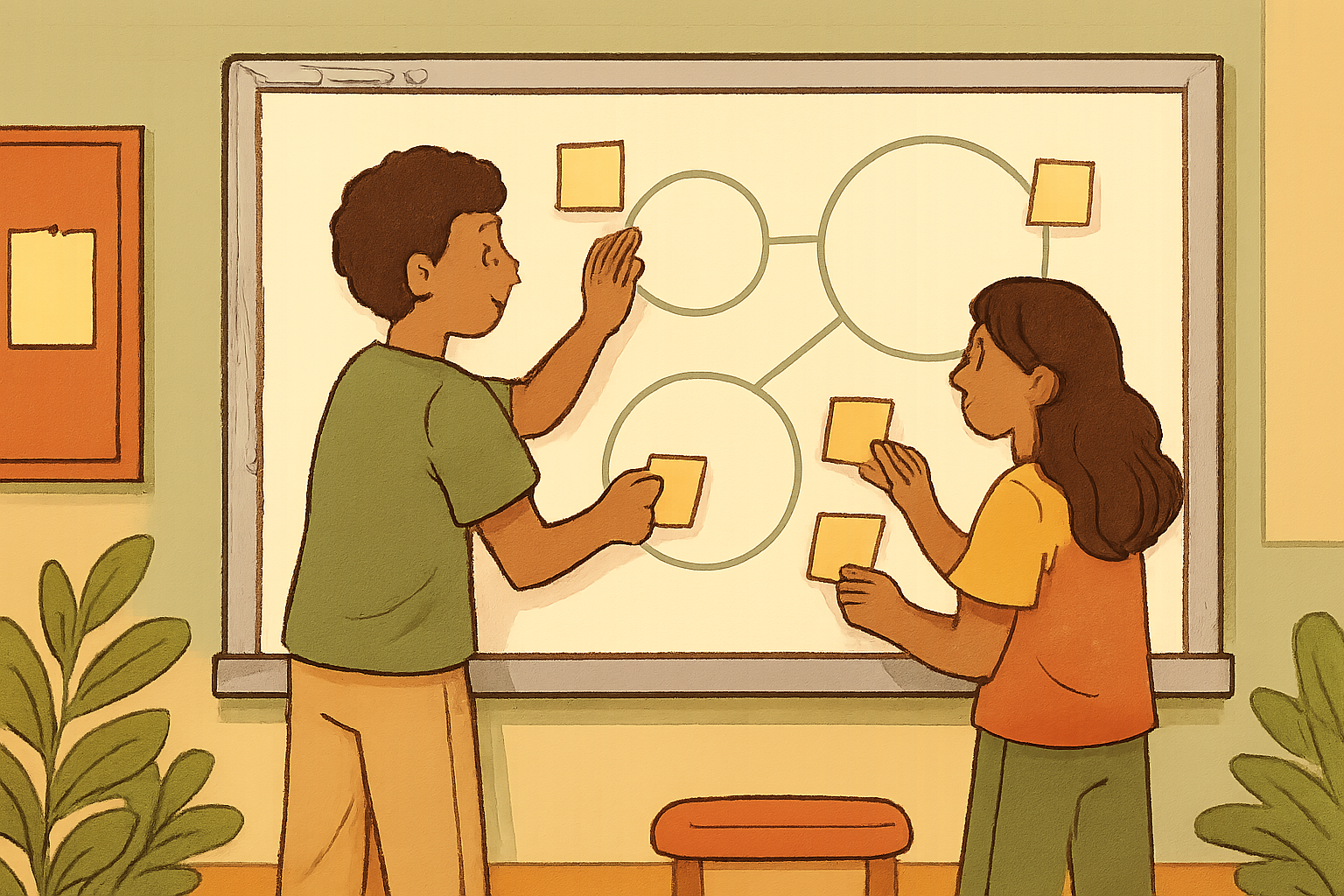
Time to put everything together. Imagine your Y9 Geography class has a group project on climate change. There are 30 pupils, split into 10 groups of three. Every group wants to use AI to help with their presentation.
If every group asks ten bloated questions of a giant frontier model, plus generates a couple of AI images each, the class alone has just spent the electricity of an evening's TV watching for a whole street. And you've barely started.
You know it doesn't have to be that way. You've got the four habits AND the tight-prompt rule. Your teacher asks for a plan.
Read the four options below out loud. Hands up on which one the class would pick. Then ask three pupils why: one for the strongest option, one for a tempting-but-weak option, one for whatever the room actually voted for. Push them to name which habit they're leaning on, and which one they've forgotten.