AI's real energy bill
What every prompt actually costs in electricity, water and hardware, and how to use AI more lightly
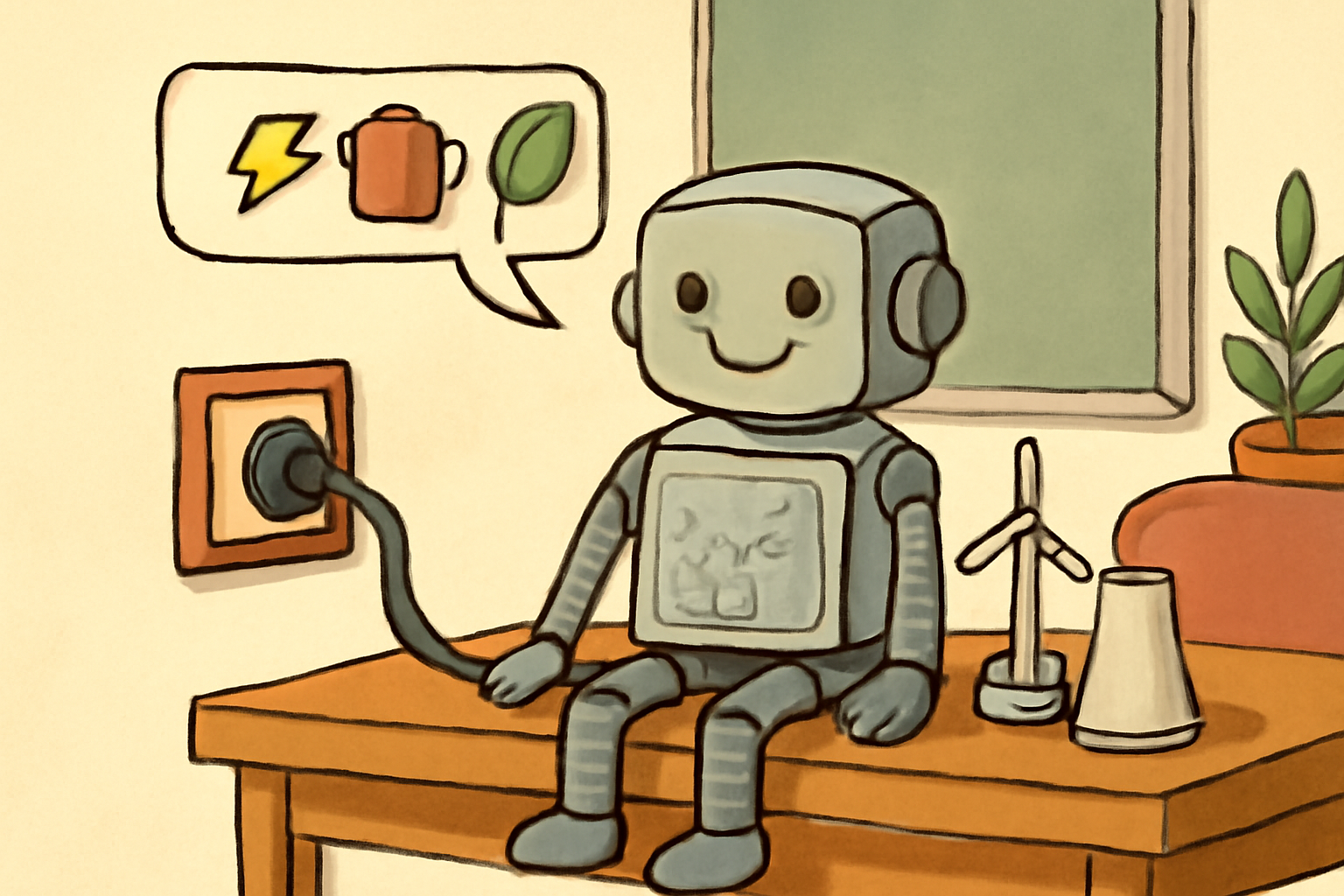
The invisible bill on every AI prompt
Before we say anything, let's see AI's energy appetite move in front of us.
Open ChatGPT (or Gemini, or Copilot) at the front, ideally on a laptop with a fan you can hear. Send the three prompts below in order. Time each response with a stopwatch. Count how many words come back. If you can, watch the free-tier usage counter tick down.
That rise in fan noise, that lengthening response time, and that visible chunk of quota you've just spent are the tiny tip of a very big iceberg.
When you tap a prompt into ChatGPT, everything about the experience is designed to feel weightless. Fast, clean, near-free at the free tier. But behind that little text bubble sits a genuinely industrial supply chain: racks of specialist chips drawing as much electricity as a small town, cooling systems evaporating thousands of litres of water, and a hardware pipeline that stretches from rare-earth mines in Inner Mongolia to fabrication plants in Taiwan.
The International Energy Agency estimated in 2024 that data centres already use somewhere around 1 to 2 percent of the world's electricity, and that AI could push that share sharply higher over the next few years. That growth is happening while you and I get used to typing 'summarise this' whenever we can't be bothered to read something.
Over the next forty minutes we'll take AI's real energy bill apart: what actually costs the electricity (spoiler: it isn't the app on your phone), where the water and hardware costs sit, and the handful of habits that can shrink your personal AI footprint by an order of magnitude without giving up any of the useful bits.
Write me a haiku about a rainy Monday morning.
Write the opening chapter of a novel set in a near-future London where sixth-form students commute by autonomous drone. About 500 words, present tense.
Here is a table of 30 Y13 pupils with their weekly homework hours, sleep hours, and predicted A-level grades across a whole term. Analyse the trends across all three variables, identify anomalies (any pupils whose pattern is unusual), and recommend three data-driven changes to the class homework and study schedule, tying each recommendation to the specific pattern it addresses. (Paste any large block of made-up numbers.)
Compare the three responses and ask the class:
- Which prompt took longest? Which returned the most tokens back? Roughly what's the ratio between the smallest and largest response?
- Text is the cheapest thing an AI can produce. Image and video generation cost roughly 10 to 40 times more per output. If we'd asked for illustrations too, how would that reshape the picture?
- Did we actually need the biggest one? Could a spreadsheet formula, a Google search, or a person have done any of these more cheaply?
- Multiply your estimate by every KS4-5 pupil in the country running similar prompts a few times a day. What order of magnitude do we land on?
Hands up: how many pupils in the room used a chatbot at least once yesterday? How many used it five or more times? Do a rough tally on the board. Multiply by the roughly 1.6 million KS4-5 pupils in England. Even a ballpark number lands the point: little clicks stack up into an awful lot of megawatt-hours when a whole cohort is clicking, and this class hasn't accounted for image generation or video yet.
Where the electricity actually goes

Almost nothing energy-intensive happens on your phone or laptop when you use ChatGPT. Your device types the prompt, ships it over the internet, waits for a response, and paints it on screen. The genuine work happens at the other end, inside a data centre: a warehouse the size of several football pitches, packed with specialist AI chips (mostly NVIDIA GPUs, plus increasingly bespoke silicon like Google's TPUs) built specifically to run large language models at speed.
Those chips draw power on a scale ordinary computers don't. A single top-end H100 GPU can pull around 700 watts under full load. A modest inference call might coordinate a few dozen such chips for a second or two. A large one might touch thousands. Every one of them needs cooling, which we'll get to in the next section.
A useful rough figure: a typical short ChatGPT query is estimated to use somewhere in the region of 3 watt-hours of electricity, compared with roughly 0.3 watt-hours for a Google search. That's the origin of the widely quoted 'about 10x more energy' claim. The exact ratio wanders depending on model, query length and how much of the answer can be cached, but the direction of travel isn't in dispute.
Draw the journey a single ChatGPT prompt takes from your phone to the answer on screen. In pairs, pupils sketch the full pipeline: device, ISP, backbone internet, data-centre entry point, load balancer, GPU cluster, response back. Mark on the sketch, in coloured pen, WHERE electricity is spent, WHERE water is used, and WHERE nothing much is happening. Share two or three sketches at the front. The point to land: the compute is real, expensive and industrial, but it's invisible to the person clicking send.
Three costs that hide behind every query
The compute electricity is the biggest single line item, but two other costs sit alongside it and both matter more than most people realise.
Before you tap the cards below, have a think: if you had to name the three physical resources a single AI query quietly consumes, what would they be?
Tap each card to reveal.
Electricity for compute
Every prompt fires up hundreds or thousands of GPUs for a brief window, each drawing hundreds of watts. Training one big frontier model like GPT-3 was estimated to have consumed roughly 1,287 MWh of electricity (comparable to the annual use of about 130 UK homes), and running the model afterwards is now believed to consume more energy in aggregate than the training did, purely because there are so many users.
Water for cooling
GPUs run hot. Most large data centres use evaporative cooling, which pumps water past the chips and lets it evaporate to shed heat. Research from the University of California, Riverside estimated that ChatGPT consumes roughly 500ml of freshwater for every 20 to 50 queries. Multiply that by a billion queries a week and it becomes a genuine strain on the aquifers around data-centre clusters, especially in dry regions like Arizona or central Spain.
Hardware and its supply chain
The GPUs themselves have an embodied carbon and materials cost. Manufacturing one advanced AI chip takes rare earths, ultra-pure water, and vast amounts of energy at the fab. TSMC's Taiwan fabs already use around 5 percent of the country's electricity. Every model refresh cycle also drives faster hardware turnover, so retired chips become e-waste sooner. This bill is paid before the first query even runs.
So each ChatGPT prompt is really drawing on three separate stocks at once: watt-hours of grid electricity, millilitres of freshwater, and a fractional slice of the embodied cost of the silicon it's running on. All three matter, and none of them appear on the free-tier user's screen.
In pairs, pupils pick one real-world AI product or feature (Midjourney, Copilot in Word, an AI-powered translation app, an image search, a coding assistant) and rate roughly which of the three costs is highest for THAT product. Share three examples at the front. Push back: an image generator's water bill tends to be worse than a text bot's; a coding assistant's compute bill dominates because it's called hundreds of times a session; a rarely-used novelty app may have a hardware bill that dwarfs its inference bill in relative terms.
The 10x figure, in context

One AI query, in isolation, is genuinely small. Around 3 watt-hours is roughly enough electricity to run an old-fashioned incandescent bulb for a couple of minutes. On its own, not a scandal.
The reason it matters is the same reason bias matters: scale, and growth. ChatGPT alone reports something in the region of a billion prompts a week, and that's just one product. Add Gemini, add Copilot in Word, add every image generator and video model, add every AI feature quietly baked into every app you use, and the numbers start to compound. The IEA's 2024 outlook flagged AI and cryptocurrency as the fastest-growing lines in data-centre demand, with total data-centre electricity potentially doubling in a few short years.
A useful mental model: text is the cheapest thing AI does. Image generation is roughly 10 to 40 times heavier per output. Short video is heavier again, sometimes by another factor of ten. So the 10x-Google figure is genuinely optimistic. It's the floor, not the ceiling. And every product roadmap is currently pushing pupils, workers and consumers gently up the ladder from text to images to video, whether we asked for that or not.
Motion: An AI query costing ten times a Google search is fine, because the answer is worth ten times more.
Split the class in two. Left side agrees, right side disagrees. Three minutes to prepare, five to hear both sides. Look for pupils who reach for scale ('multiply by a billion...'), pupils who question the assumed value ('was that answer really ten times more useful than a search?'), and pupils who spot that the same person often uses AI where a search would have done. Wrap with a hands-up vote AFTER the debate, not before.
Four habits that shrink the footprint

You don't have to boycott AI to use it more lightly. Four habits, applied routinely, will cut most of the waste out of an average KS4-5 pupil's AI use, and every one of them will also make you a better user.
Before you tap the cards below, have a think: if you were writing a one-page 'use AI more lightly' guide for the sixth form common room, what would you put on it?
Tap each card to reveal.
Ask if AI is even the right tool
A search engine, a calculator, a well-organised set of notes, or your own head is often faster, cheaper, and dramatically less energy-intensive than a language model. Reach for AI when you actually need what it's uniquely good at, not by reflex. This one habit alone will cut a typical pupil's AI use by a large chunk.
Use the smallest model that gets the job done
The frontier models (GPT-4o, Claude Opus, Gemini Ultra) are extraordinary, and they cost several times more per query in both money and energy than the smaller siblings (GPT-4o-mini, Claude Haiku, Gemini Flash). For a translation, a summary, or a quick definition, the smaller model is roughly as accurate and roughly a tenth of the cost. Most apps let you choose.
Batch, don't drip
Every prompt is a fresh round-trip to the data centre with its own fixed overhead. One prompt containing five well-scoped questions is far cheaper than five separate prompts, and often produces a more coherent answer because the model can see all your questions at once.
Tighten your prompts, and the answers you ask for
Padding costs the same as content on the way in, and long-winded prompts trigger long-winded answers on the way back. Name the audience, name the format, name the length. 'One paragraph, no preamble' or '5 bullet points, one line each' will save you tokens both ways.
None of these habits are self-denial. Each one produces a better output for less energy. That's a rare combination, and it's worth building into how you use AI from Y10 onwards, because AI is only going to get more embedded in the next stage of your education and career.
Give the class one task, for example: 'Translate this paragraph of French into English.' Half the room runs it on the flagship model (GPT-4o, Claude Sonnet, whatever your school licence provides). The other half runs it on the light model (GPT-4o-mini, Claude Haiku). Bring the two outputs together at the front. Ask the class to spot the difference in quality. In most cases they won't, or the difference will be trivial. Point out the roughly ten-to-one cost gap they've just saved by not defaulting to the flagship.
Bad prompt, good prompt

The four habits catch waste at the level of how you use AI. There's also something you can do BEFORE you press return: write a lighter prompt.
Every token you send costs a bit of compute (which means a bit of electricity, a bit of water and a bit of hardware wear). Every token the AI generates in reply costs more. So the game is: get the same information for the fewest tokens across the whole exchange, and pair it with the right-sized model.
The two prompts below ask for the same thing. One will cost roughly four to ten times the energy of the other for essentially the same information, depending on which model tier you're on.
Hi there! I hope you're doing well today. I was wondering if you would be so incredibly kind as to please help me out with my A-level Geography revision. I really need to properly understand the causes of desertification, so could you write me a really thoughtful, detailed, thorough explanation covering all of the main causes, with lots of interesting examples and case studies and figures, in a way that will really help me remember it for my exam? Thank you so, so much in advance!
Roughly 90 tokens in, run on a flagship model, which then mirrors the tone back with 800+ tokens of expansive answer. The wall of text is harder to revise from, AND you've spent maybe 10 times the electricity of a properly-scoped version.
List the 5 main causes of desertification for A-level Geography. One sentence each, plus one named real-world example per cause. No introduction, no summary.
Roughly 25 tokens in, run on a lighter model like GPT-4o-mini or Gemini Flash, returning a compact ~100-token answer. Same revision content, roughly a tenth of the energy across the whole exchange, and it's easier to memorise.
In pairs, pupils rewrite each bloated prompt below in under 30 words WITHOUT losing the point, then run both versions at the front (bloated on flagship, tight on the lighter model tier your school licence gives you) and compare both length and quality.
- Please could you kindly, when you get a moment, give me a really detailed and thorough summary of the whole plot of Macbeth for my A-level revision, including all the main characters and themes, with lots of quotes if possible, thank you very much!
- Hi! Would it be alright if you helped me with my Chemistry homework? I'd love a nice long explanation of ionic bonding, please, with as many examples as you can think of.
- I was hoping you might be able to write me a fairly substantial paragraph or two on the causes of the French Revolution, ideally in a way that would be suitable for a Y12 History student, thank you so much!
Celebrate the tightest rewrites. Test one live and let the class judge whether anything of substance was lost.
So what would you do?
Time to put it all together. Imagine you're a Y13 doing an EPQ on air quality in your local area. You've been given a school API key with a fixed monthly token budget shared across your class, and you're two weeks in.
You've been defaulting to GPT-4o for everything, sending a chatty prompt every time you have a small question, and generating multiple variant AI images 'just to see which one looks best'. Your tutor emails to say the class has already burned through 70 percent of the shared monthly budget, and you're the top individual user.
You've got the four habits AND the tight-prompt rule. You need a plan for the rest of the project.
Read the four options below out loud. Hands up on which one the class would pick. Then ask three pupils why: one for the strongest option, one for a tempting-but-weak option, one for whatever the room voted for. Push them to name which habit (or which combination) they're leaning on, and which one their favoured option ignores.