Same question, different answer
Why the AI never says it quite the same way twice
The AI that never says it twice
Before we say anything, let's watch it happen.
Pick one of the prompts below. Copy it. Paste it into any text AI you have to hand (ChatGPT, Gemini, Microsoft Copilot, Claude). Send it. Then send exactly the same prompt again in a brand new chat window. Then a third time. Do NOT change a single word between runs.
Look at the three answers side by side.
You just typed exactly the same prompt into an AI two or three times in a row and got noticeably different answers back. Same words, same account, no gap between the tries, and yet the AI still couldn't quite repeat itself.
That isn't a bug and it isn't a memory glitch. It's how these systems are built to behave. Once you understand where the variation comes from, a lot of AI's strange habits start to make sense: why one draft is brilliant and the next is bland, why a group of pupils asking the same revision question get subtly different answers, why coding assistants suggest a slightly different fix every time.
Over the next twenty-five minutes we'll take that apart, work out where the guessing actually happens, and finish with a small set of habits that tell you when different-every-time is a superpower and when it's a trap.
Please give me a random number between 1 and 100. Just the number, no explanation.
Please write me a two-sentence spooky story set in a school locker at midnight.
Please write me a caption for a photo of a dog looking very guilty next to a chewed-up school shoe.
Look at the three answers side by side and ask the class:
- Are any two of the answers exactly the same? Which parts changed?
- Which run is the 'right' one? Or is that not really a fair question here?
- If a whole class asked the AI the same revision question at the same moment, would they all get the same answer? Would they all get a correct answer?
- Where do you think the variation is coming from?
The AI rolls dice for every word
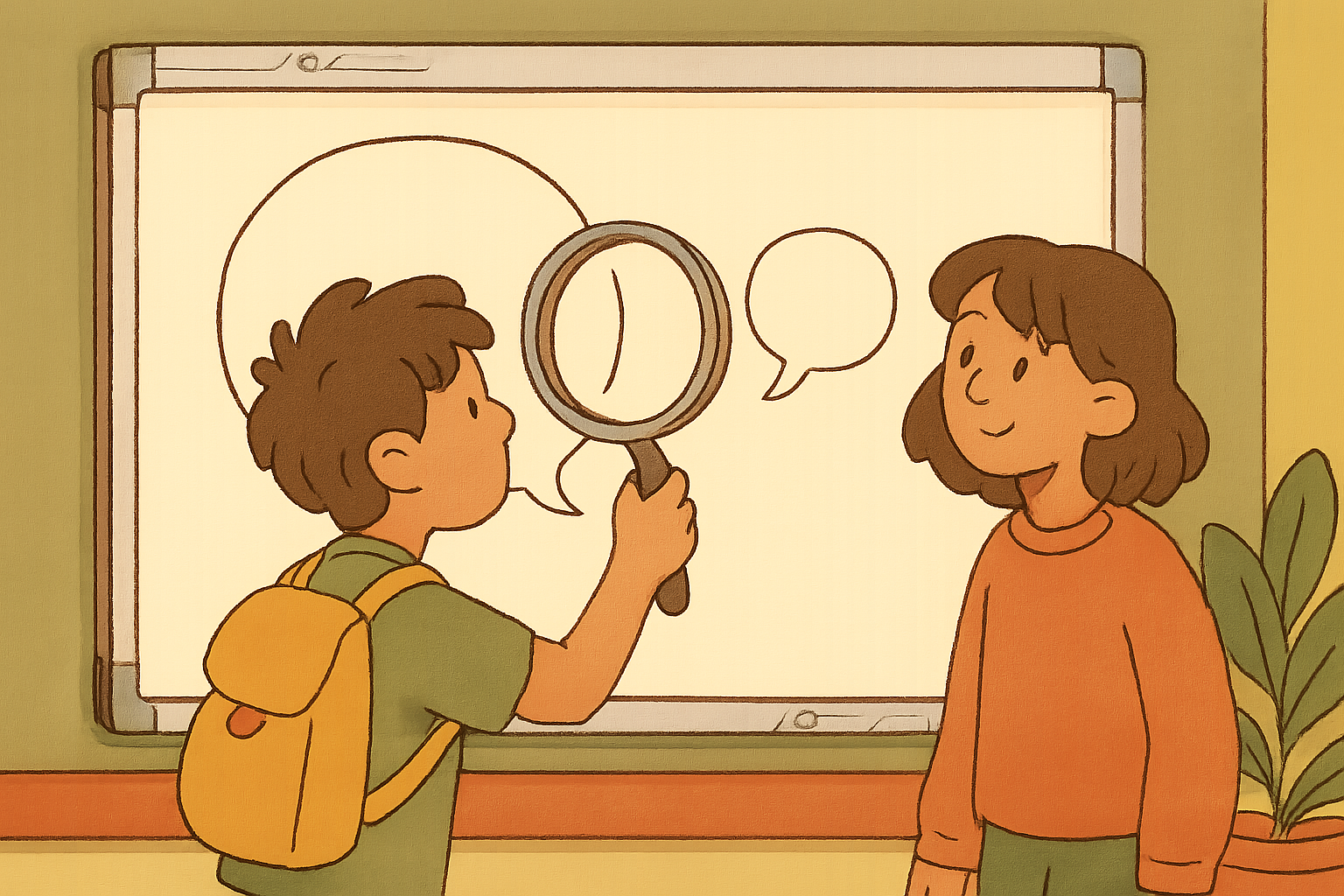
The AI doesn't pull answers out of a database. When it writes a reply, it builds it one small piece at a time. At every step it has a list of possible next-words, each with a percentage attached: 'the' 34%, 'a' 19%, 'one' 8%, and so on down the list. Then it rolls a weighted dice and picks. The higher the percentage, the more likely a word gets picked, but the roll is real.
That single design choice, repeated hundreds or thousands of times across a single answer, is why the same prompt can send the AI down completely different paths. Word three lands slightly differently, which changes the odds for word four, which changes word five, and by word twenty you've got a totally new sentence.
The proper name for this is non-determinism: same input, different output. It's not a fault the developers are secretly trying to fix. Turning it off would make the AI feel like a stuck record, so a bit of variety is deliberately dialled in.
Three places the guessing hides
The randomness isn't in one place you can point to and switch off. It sits at three different levels of the AI, and knowing which is which helps you predict how weird any given answer will be.
Before you tap the cards, have a quick guess: if you were building an AI and you wanted to control how random the answers came out, where would you put the dial?
Tap each card to reveal.
The temperature setting
There's a literal dial called temperature. Low temperature makes the AI stick close to the top-ranked next-word every time, so answers get more predictable. High temperature spreads the odds around, so answers get more creative and stranger. Most public chatbots hide this dial, but developers can set it in their code.
The word-by-word dice
Even at a low temperature, most models still roll dice at every word. Two runs might match for the first ten words and then split hard on word eleven. From there, the two answers can head in totally different directions, because each word depends on the one before it.
The quiet model updates
The AI you use today isn't necessarily the AI you used last month. Providers retrain and tweak their models regularly, often without saying so. So even if you'd frozen the dice, the dice-thrower itself is being upgraded in the background.
So even if you type the exact same words, from the same account, at the same second, you can't guarantee the exact same answer back. It's randomness on top of randomness on top of quiet change.
When it helps, and when it bites
The randomness is a superpower for some tasks and a disaster for others. The whole trick is to notice which is which BEFORE you use the answer for anything that matters.
If you're brainstorming captions for a school newsletter, five different options is EXACTLY the point. If you're double-checking the answer to a GCSE percentages question, five different numbers means at least four of them are wrong.
The mismatch happens when we treat the AI like a calculator and it acts like a poet. The AI doesn't know which mode you meant. It just rolls the dice on every word and hopes for the best.
Four habits to stay ahead of it
Once you know the AI is a probability machine, four small habits will save you a lot of grief in day-to-day school work.
Before you tap the cards, have a guess: if you were teaching a Y7 sibling to use AI without getting burned, what would you tell them?
Tap each card to reveal.
Ask twice
If you're planning to trust an answer, run the same prompt a second time in a fresh chat. If the two answers agree, the AI is probably confident. If they disagree, at least one of them is a guess and you need to dig deeper.
Compare two AIs
Same idea, stronger version. Paste your question into ChatGPT and Gemini (or Copilot, or Claude). Where they agree, the answer is probably solid. Where they disagree, that's your signal to check with a proper source.
Never for maths, spelling, or dates
Any question with exactly one right answer is a poor fit for a dice-rolling machine. Use a calculator, a dictionary, or a proper reference. AI is fine as a starting sketch but check anything that has to be factually right.
Embrace it for creative work
Brainstorming, drafting, name-generating, poem-writing, image-making: the randomness is a feature. Ask for five options, not one. Pick the best. Bin the rest.
These four habits together let you get the fun of AI without the traps. The whole game is knowing which mode you're in.
Bad prompt, good prompt
You can't fully switch off the guessing (see the three places from earlier), but you CAN nudge the AI towards a more consistent kind of answer by being much more specific about what you want.
Vague prompts leave lots of room for the dice to swing. Tight prompts give the dice much less room to matter. The two prompts below ask for the same thing, but only one of them will give you answers you can actually compare and choose between.
Give me a good name for a school science club.
This prompt is wide open. On five runs you'll get five wildly different vibes: cutesy, formal, sciencey, punny, boring. You can't compare them because they're aiming at completely different targets. The dice have full range.
Give me five name ideas for a Y8 science club. Each name should be two words, fun but not childish, and land somewhere between 'discovery' and 'experiment' in feel. Give me a one-line reason for each.
The constraints (count, length, audience, tone, feel, format) narrow the target massively. Five runs will still give different names, but they'll all be recognisably in the same ballpark. Now you can actually pick a winner.
So what would you do?
Time to put it all together. You're revising for a GCSE Maths mock. You ask ChatGPT to solve a percentages question, and it tells you the answer is 42.5.
You try again in a fresh chat to be safe, and this time it tells you 45.
The AI has just given you two different answers with equal confidence. Your mock is tomorrow. You know what non-determinism is now and you know the four habits. You need a plan.